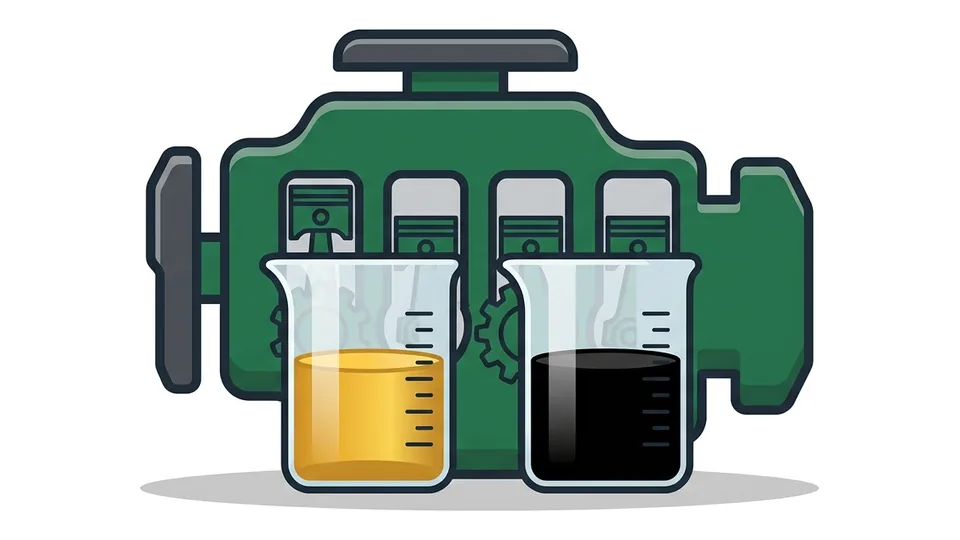
Diesel oil that turns black quickly is usually normal. Diesel engines produce soot, and diesel oils are formulated to hold that soot in suspension instead of letting it settle in the engine. Colour alone does not tell you the oil is spent, so use the change interval in your owner’s manual. What deserves attention is black oil with abnormal signs — see section 3.
1. Why diesel oil darkens fast
Castrol explains that diesel engines tend to generate soot, from incomplete combustion, and some of it reaches the crankcase through blow-by gas. Diesel oils therefore carry higher levels of detergent and dispersant additives, which “disperse the soot particles and hold them in suspension” to prevent viscosity increase, varnish, sludge and wear.
With fine soot spread through the oil, the oil darkens. Chevron’s Delo data sheet says its dispersant system keeps insoluble contaminants finely suspended, which limits their ability to block oil filters.
So oil that is black from soot means the dispersants are still working. It does not mean the oil has failed.
2. Colour does not say when to change
Mobil states that oil can change colour without any lubrication problem, and that a colour change does not by itself mean the oil has degraded (Mobil’s page is general, not diesel-specific). It points to laboratory oil analysis rather than colour.
If you do not send samples to a lab, the reliable approach is the interval in the manual. The table below comes from the Thai owner’s manuals summarised on this site.
| Model | Oil change interval per manual |
|---|---|
| Hilux Revo 2.4 | Every 10,000 km or 12 months, filter each time (Thailand row) |
| Fortuner 2.4/2.8 | Every 10,000 km or 12 months · severe use every 5,000 km or 6 months |
| D-Max 1.9 Ddi | Every 10,000 km or 6 months · filter every 20,000 km or 12 months |
| Ranger 2.0 | This manual has no interval table; see Ford Thailand’s maintenance schedule for your sub-model |
| Triton 2.4 | This manual has no interval table; it is in a separate maintenance booklet |
Each interval is “km or months, whichever comes first.” None uses oil colour as the trigger. If you drive hard (heavy loads, towing, frequent traffic), check the severe-use conditions in your own manual. More in How often to change engine oil.
3. When black is abnormal
Black alone is not enough to judge. Look at these too.
| What you see | Possible meaning | What to do |
|---|---|---|
| Thick, sludgy, clumpy | The eye cannot tell the cause (contamination, or oil kept past its interval) | If past the interval, change it. If thick before the interval, have a service centre check |
| Strong diesel smell, or level above the upper mark | Fuel in the oil | Have a service centre check; see below |
| Milky, or cream-coloured on the dipstick | Water or coolant in the oil | See Milky engine oil. If the whole dipstick is milky, stop driving and have a mechanic check |
| Metal flakes or glitter on the dipstick or in drained oil | Possibly worn parts | Do not guess; have a service centre or trusted workshop inspect before driving on |
| Level dropping fast | Leak or oil burning | See Checking oil level and consumption and Exhaust smoke colour |
Fuel in the oil. Castrol says diesel in the oil lowers its viscosity, thins the oil film and dilutes the anti-wear additives. Confirming it needs a laboratory, and because diesel is volatile, the true level can be higher than measured. Ask the vehicle maker about acceptable limits. On some models with a particulate filter, the level can rise after regeneration; see D-Max 1.9: oil level rising and Revo / Fortuner DPF warning. If the level is above the maximum, do not keep driving without asking a service centre.
Oil pressure warning light on. This has nothing to do with colour. Stop in a safe place immediately. See Oil pressure warning light.
4. Diesel oil grades and soot control
Diesel oil standards include soot tests.
- API CK-4 — API says it is designed to protect against soot-related viscosity increase, along with oxidation, viscosity loss from shear and aeration.
- API CI-4 / CJ-4 — API describes protection against viscosity degradation from soot accumulation (CI-4) and soot handling (CJ-4). CI-4 PLUS is an extra mark that API says gives higher protection against soot-related viscosity increase.
- ACEA E sequences (trucks/heavy duty) — ACEA uses “soot handling” in E4, E7, E8 and E11.
But always choose by the owner’s manual, not by picking the highest grade to make oil darken more slowly. For example, Hilux Revo / Fortuner EURO V/VI trucks must not use oil outside ACEA C5, C2 or JASO DL-1, and Triton versions with a DPF need ACEA C1–C4 and JASO DL-1, because the wrong oil can harm the exhaust after-treatment. For grade-by-grade detail see CK-4 vs FA-4, and for choosing see Engine oil for diesel pickups.
5. Quick checklist
- Find the interval (km or months) in your manual and note the date and odometer of the last change.
- Check the level on level ground with a cold engine, as the manual describes. It should sit between the marks, not rising or falling fast.
- Look at and smell the oil on the dipstick for diesel odour, milky colour or metal flakes.
- If everything is normal and it is only dark, do not change early because of colour.
- If any abnormal sign appears, contact a service centre.
Quick summary
- Fast-darkening diesel oil is usually normal. Dispersants hold soot in suspension, as oil makers explain.
- Colour does not set the change time. Use the manual interval (Revo/Fortuner 10,000 km or 12 months; D-Max 1.9 10,000 km or 6 months).
- Abnormal means thick like mud, diesel smell or rising level, milky colour, metal flakes, or fast-dropping level.
- Oil pressure light on means stop immediately.
- Choose grade by the manual, especially for EURO V/VI or DPF trucks, not by how fast the oil darkens.
See products in Diesel engine oil