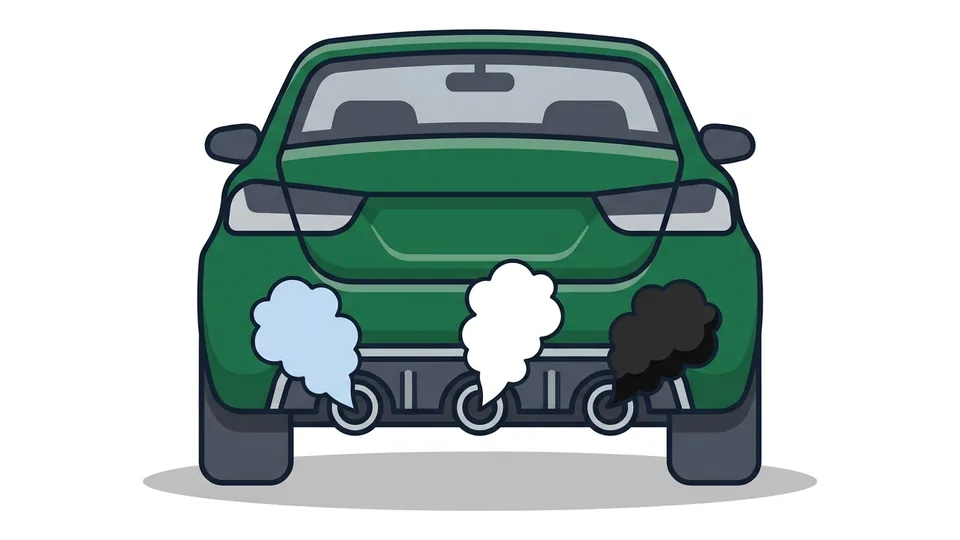
Exhaust colour gives a rough clue about what is being burned in the combustion chamber. Blue/grey = engine oil · black = too much fuel · thick white that does not clear when the engine is warm = possibly coolant. Thin white vapour that clears quickly may be plain steam. This guide helps you sort the first signs. It does not replace a mechanic. The real cause needs a proper inspection.
1. Colour table
| Colour | When you see it | Possible causes (a mechanic must check) | What to do |
|---|---|---|---|
| Thin white vapour | Cold mornings, humid or rainy weather, gone within minutes once warm | Condensation in the exhaust evaporating | Normal. Just confirm it clears |
| Thick white, persistent | Continues after the engine is warm | Coolant entering the combustion chamber (e.g. head gasket, cracked head or block) | Stop driving. Call a mechanic or tow. See section 3 |
| Blue/grey | At start-up, under acceleration, or constantly | Engine oil being burned, e.g. piston rings, valve seals, turbo leaks | Note the oil level and have it checked. See section 2 |
| Black | Accelerating, heavy load, or constantly | Too much fuel or too little air, e.g. clogged air filter, injectors, EGR, turbo | Check the air filter, then have the system inspected. See section 4 |
2. Blue/grey smoke — engine oil being burned
Mobil says blue or blue/black smoke may mean oil is being burned along with the fuel. Causes named by manufacturers include worn piston rings, leaking valve seals or guides, and a turbo with leaking bearings (Wynn’s).
What you can check yourself
- Log the oil level against mileage. If it drops fast, see how to tell leaking from burning in Checking oil level and consumption
- Note when the smoke appears (cold start, acceleration, or all the time) and tell the mechanic. It helps narrow the cause
What not to do
- Do not “fix” it with thicker oil. Oil does not repair worn parts and can hide the symptom until the problem grows. The grade must follow your manual. See Mileage and engine oil grade
- Do not expect an additive to cure blue smoke. See Are engine additives worth it?
If blue smoke is constant or comes with loss of power, have it inspected. If the oil-pressure warning light comes on, stop immediately and do not drive on.
3. Thick white smoke — do not keep driving
Thin white vapour in the morning can be normal. Mobil says white smoke may simply be moisture in a cold engine and exhaust burning off, but a lot of white smoke that continues for a long time may mean an internal coolant leak.
How to tell them apart
- Normal → thin vapour at a cold start that clears once warm
- Suspicious → thick white smoke continuing with a warm engine, the coolant reservoir level falling with no puddle under the car, or the temperature gauge reading high
Coolant has a sweet smell (AAA lists an odd sweet smell as a sign of a coolant leak), but do not rely on smell alone.
If you suspect the second case, stop, switch off and call a mechanic or tow. Driving on with an overheating engine risks serious damage. Never open the radiator cap on a hot engine. See Engine overheating — what to do and Radiator coolant guide.
Topping up coolant only helps you limp to the workshop. It does not fix the cause.
4. Black smoke — too much fuel or incomplete combustion
Mobil says black smoke means excess fuel is being burned. Wynn’s says it happens when the engine gets too much fuel relative to air, with clogged air filters, injectors delivering too much fuel, and faulty sensors (oxygen or air-flow) named as causes.
Thailand’s Pollution Control Department (Environment and Pollution Control Office 14) advises diesel owners to check injectors, adjust injection timing, clean the exhaust system, change oil and filters on schedule, maintain the air filter, and inspect the engine.
First checks on a diesel
- Air filter — is it clogged or very dirty? The easiest check
- Load and driving style — heavy loads or hard acceleration can show temporary black smoke
- Injectors, EGR, turbo — need a mechanic with proper tools. Do not guess
Diesels with a DPF (diesel particulate filter) trap soot before it leaves the tailpipe. UD Trucks lists thicker black or white smoke, a burnt smell, warning lights and power loss among DPF failure symptoms. So on a DPF vehicle, clearly visible black smoke should be treated as abnormal and checked by a dealer. Whether your model has a DPF is in the manual or from the dealer.
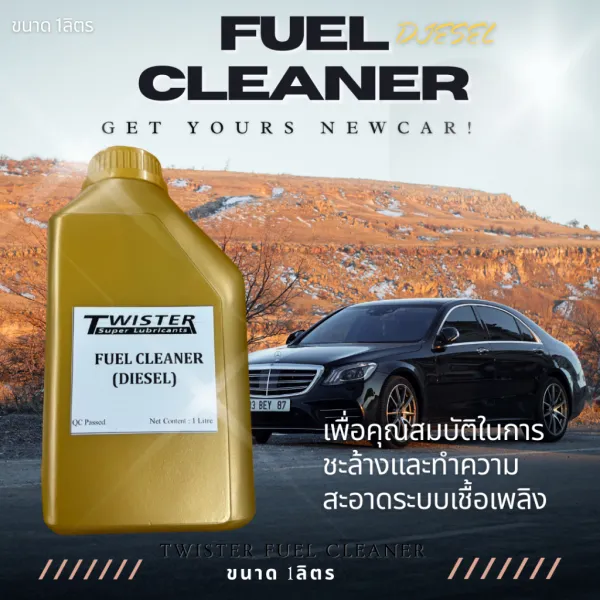
On fuel additives: a diesel fuel-system cleaner can only help clean the fuel system as its label says. It does not repair damaged injectors or pumps, and we do not claim it cures black smoke. If you see black smoke, find the cause first.
5. Thai rules — diesel black smoke
Thai authorities test diesel black smoke by opacity.
- Current limit: no more than 20% (previously 30%), effective 1 November 2025 (B.E. 2568) (Environment and Pollution Control Office 14 / Pollution Control Department)
- MGR Online, citing the Department of Land Transport, reports opacity measured over a 76 mm light path
- If exceeded, the fine can be up to 5,000 baht and the vehicle can be banned from use (sprayed “ห้ามใช้” / “do not use”) until repaired and re-tested (Office of Natural Resources and Environmental Policy and Planning, citing the 2022 rule; 2025 reporting gives the same penalty)
- Black-smoke vehicles can be reported to the Department of Land Transport hotline 1584
Limits can change. Check the latest Department of Land Transport announcement before an inspection.
Quick summary
- Thin white vapour that clears when warm = steam, normal
- Thick white that does not clear = possibly coolant in the combustion chamber → stop, call a mechanic, do not open the radiator cap when hot
- Blue/grey = oil being burned. Have it inspected. Do not “fix” it with thicker oil or additives
- Black = too much fuel. Start with the air filter, then have injectors, EGR and turbo checked
- Diesel black smoke above 20% risks a fine and a ban on use (limit since 1 Nov 2025)
See products: Diesel engine oil · Gear oil, brake and radiator fluids