Coolant type, capacity and change interval depend on the model. The tables below are taken from each model’s Thai-language owner’s manual. For example, the Toyota Yaris Ativ lists a first change at 160,000 km, the 2006 Honda Civic lists 200,000 km or 10 years, and some hybrids have a separate inverter coolant loop apart from the engine loop (table C).
This page covers only the models on our cars pages. Every value is copied from that model’s Thai-language owner’s manual (page numbers are on each model page). A ”—” means our data has no value there; check your own manual. For how to choose coolant and how dilution works, read Radiator coolant.
Safety: never open the radiator cap or the reservoir cap while the engine is hot; pressurised coolant and steam can scald (engine overheating).
Table A — cars (engine coolant loop)
Sorted by make. A model with several rows means the manual gives separate values by variant or loop.
| Model (manual year) | Coolant per manual | Capacity | Change interval |
|---|---|---|---|
| Ford Everest 2.0 diesel turbo / bi-turbo (2026) | WSS-M97B57-A2 (yellow), pre-diluted; no additives | Automatic without heater 8.4 L · manual without heater 8 L · with engine heater 9.6 L | — |
| Ford Focus 1.6 / 1.8 / 2.0 petrol (2005) | Motorcraft Super Plus Antifreeze to WSS-M97B44-D, mixed 50:50 with water | Incl. heater: 1.6 6.0 · 1.8 6.5 · 2.0 6.3 L | — |
| Ford Ranger 2.0 diesel turbo / bi-turbo (2022) | WSS-M97B57-A2 (yellow); do not mix colours or types | Single-turbo MT 8 L · AT 8.4 L · bi-turbo 9 L · with engine heater 9.6 L · with fuel-fired heater 9.7 L | — |
| Ford Ranger 2.2 diesel (TDCi) (2018) | Motorcraft orange WSS-M97B44-D2 or yellow WSS-M97B57-A2; never mix colours or types · 50/50 mix, 48–50% concentration | Manual (MT82) 11.5 L · automatic 11.9 L | — |
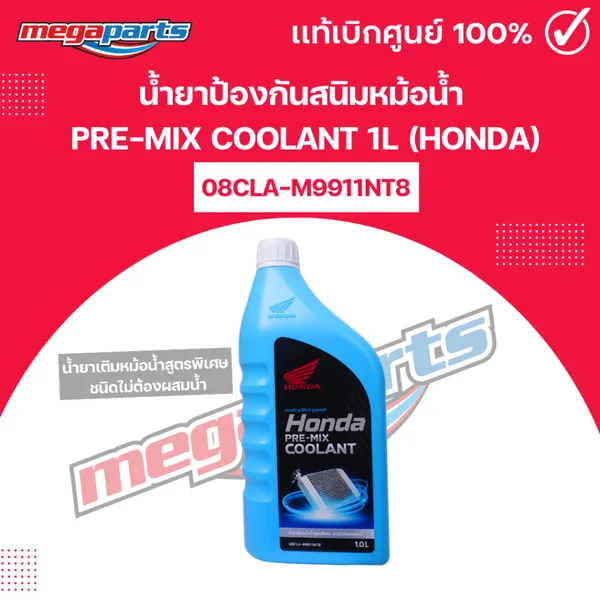
| Honda BR-V 1.5 petrol (i-VTEC) CVT (2022) | Honda All Season Antifreeze/Coolant Type 2, pre-mixed 50/50 with distilled water; never add neat antifreeze or plain water | 3.66 L (incl. 0.42 L left in the reserve tank) | — |
| Honda City Hatchback 1.0 turbo petrol CVT (2026) | Honda All Season Antifreeze/Coolant Type 2, 50/50 with distilled water | 5.19 L (incl. 0.6 L reserve tank) | Replace at 200,000 km or 120 months |
| Honda Civic FD 1.8 petrol (R18A) (2006) | Honda Long Life Antifreeze/Coolant Type 2 | Drain and refill: MT 5.2 (with heater) / 4.6 L · AT 5.5 (with heater) / 4.9 L | First at 200,000 km or 10 years, then every 100,000 km or 5 years |
| Honda Civic 2.0 e:HEV hybrid (2026) | Honda All Season Antifreeze/Coolant Type 2, 50/50 with distilled water | 5.54 L (incl. 0.62 L reserve tank) | — |
| Honda CR-V 2.0 e:HEV hybrid (2026) | Honda All Season Antifreeze/Coolant Type 2, 50/50 with distilled water | 5.70 L (incl. 0.72 L reserve tank) | — |
| Honda HR-V 1.5 e:HEV hybrid (2022) | Honda All Season Antifreeze/Coolant Type 2, mixed 50/50 | 4.22 L (incl. 0.45 L reserve tank) | — |
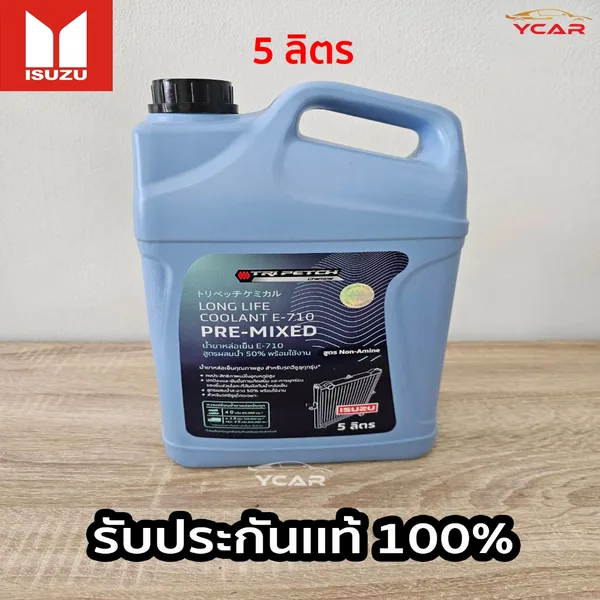
| Isuzu D-Max 1.9 Ddi diesel (RZ4E-TC) (2024) | Isuzu / Tri Petch Longlife Coolant E-710 Pre-Mixed | Auto A/C: MT 10.3 / AT 10.7 L · manual A/C: MT 9.6 / AT 10.0 L | First at 160,000 km or 96 months, then every 80,000 km or 48 months (every 2 years with other Isuzu-recommended brands) |
| Isuzu D-Max 3.0 Ddi diesel (4JJ3-TCX) (2026) | Longlife Coolant E-710 Pre-Mixed (50%) — the manual requires pre-mixed coolant for the 4JJ3 | Auto A/C: MT 10.3 / AT 11.1 L · manual A/C: 9.7 / 10.5 L | First at 160,000 km or 96 months, then every 80,000 km or 48 months (every 2 years with other Isuzu-recommended brands) |
| Isuzu MU-X 1.9 / 3.0 diesel (RZ4F-TC / 4JJ3-TCX) (2026) | Longlife Coolant E-710 Pre-Mixed (50%) — the manual requires pre-mixed coolant for the 4JJ3 | 3.0: auto A/C 11.1 L · manual A/C 10.5 L · 1.9: auto A/C 10.2 L · manual A/C 9.5 L | First at 160,000 km or 96 months, then every 80,000 km or 48 months (every 2 years with other Isuzu-recommended brands) |
| Isuzu MU-X 1.9 diesel, older engine (RZ4E-TC) (2025) | Longlife Coolant E-710 Pre-Mixed (50%) — the manual requires pre-mixed coolant for the RZ4E | Auto A/C 10.7 L · manual A/C 10.0 L | First at 160,000 km or 96 months, then every 80,000 km or 48 months (every 2 years with other Isuzu-recommended brands) |
| Mazda CX-30 2.0 petrol (SKYACTIV-G 2.0) (2021) | Engine coolant type FL-22 (FL22 mark on the cap) · other types may damage the engine | 6.4 L (right-hand drive) | First change at 200,000 km or 10 years, then every 100,000 km or 5 years |
| Mazda Mazda2 1.3 petrol / 1.5 diesel (SKYACTIV-G/D) (2023) | Engine coolant type FL-22 (FL22 mark on the radiator cap) · other types may damage the engine | Petrol 1.3: 5.4 L (with heater) / 4.9 L (without) · diesel 1.5: 6.8 L, plus 2.0 L for models with the water-cooled A/C system (as in the manual table) | First change at 200,000 km or 10 years, then every 100,000 km or 5 years |
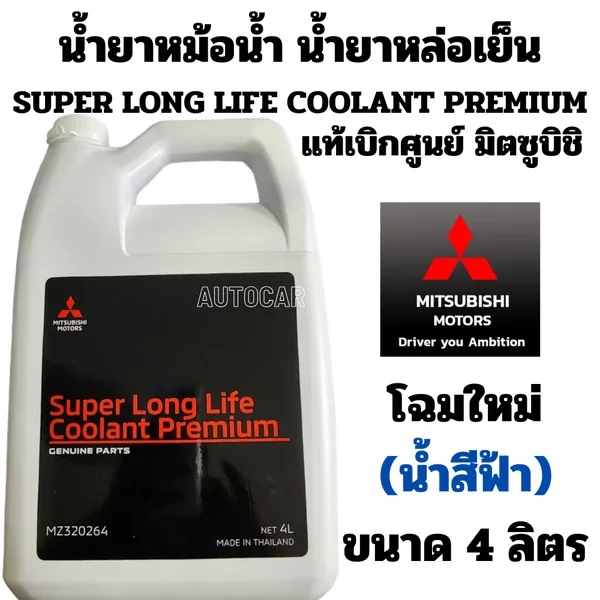
| Mitsubishi Attrage 1.2 petrol (3A92) CVT / manual (2020) | MITSUBISHI MOTORS GENUINE SUPER LONG LIFE COOLANT PREMIUM or equivalent (ethylene glycol, free of borate, nitrite, amine and silicate, hybrid organic long-life technology); never plain water alone | Manual 3.6 L · CVT 4.3 L (both include the 0.5 L reserve tank) | — |
| Mitsubishi Pajero Sport 2.4 diesel (4N16) (2026) | MITSUBISHI MOTORS GENUINE SUPER LONG LIFE COOLANT PREMIUM or equivalent (ethylene glycol, free of borate, nitrite, amine and silicate, hybrid organic technology for long life) | 7.0 L (including 0.75 L reserve tank) | — |
| Mitsubishi Triton 2.4 diesel (4N16) (2024) | MITSUBISHI MOTORS GENUINE SUPER LONG LIFE COOLANT PREMIUM or equivalent (ethylene glycol, non-silicate/amine/nitrite/borate, hybrid OAT) | Type 1 (condenser tank cap) 6.9 L · Type 2: High Power 8.5 / Super High Power 9.0 L | — |
| Mitsubishi Xpander 1.5 petrol (4A91) (2023) | MITSUBISHI MOTORS GENUINE SUPER LONG LIFE COOLANT PREMIUM or equivalent (ethylene glycol, free of borate, nitrite, amine and silicate, hybrid organic technology for long life) | 5.0 L (including 0.65 L reserve tank) | — |
| Nissan Almera 1.0 turbo (HRA0DET) (2026) | Genuine Nissan coolant (blue) or equivalent quality | With heater 6.7 L · without heater 6.2 L (including 0.7 L reserve tank) | — |
| Nissan Almera 1.2 petrol (HR12DE) (2018) | Genuine Nissan engine coolant (blue) or equivalent quality | MT 5.7 L · CVT 5.8 L (both include the 0.7 L reserve tank) | — |
| Nissan Kicks e-POWER 1.2 e-POWER (HR12DE) (2026) | Genuine Nissan engine coolant (blue) or equivalent quality · mix with clean water 30% (to -15 °C) or 50% (to -35 °C) · no additives or sealers | Total 6.25 L (reserve tank 0.74 L) | — |
| Nissan Navara 2.3 diesel (YS23DDT/DDTT) (2025) | Genuine Nissan coolant or equivalent, pre-mixed 50% (protects to −35 °C) · no additives | Reserve tank type A: with heater 11.1 / without 10.5 L · type B: with heater 11.3 / without 10.7 L | — |
| Suzuki Swift 1.2 petrol (K12M) CVT (2019) | SUZUKI LLC: Super coolant (blue), pre-mixed — do not dilute further with distilled water | 4.7 L (incl. reserve tank) | Replace at 60,000 km or 36 months (the manual’s table runs to 100,000 km) |
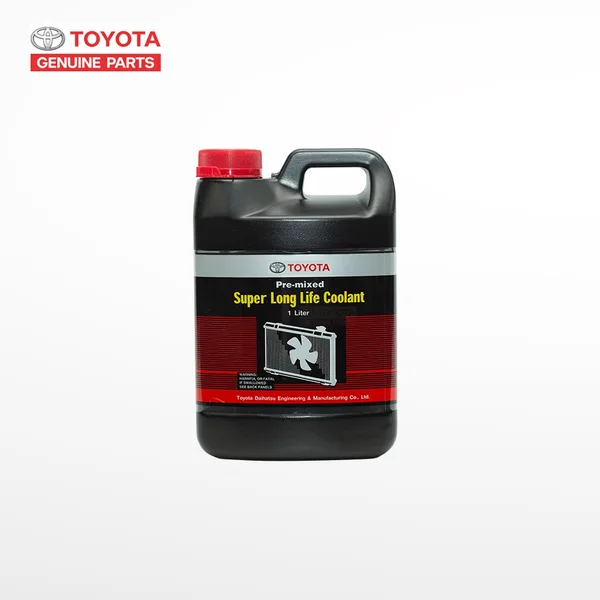
| Toyota Camry ACV40 2.0/2.4 petrol (1AZ/2AZ-FE) (2006) | Toyota Super Long Life Coolant or an equivalent ethylene-glycol coolant without silicate, amine, nitrite or borate; never plain water | 6.2 L (total) | First at 160,000 km, then every 80,000 km |
| Toyota Corolla Altis 1.8 petrol / hybrid (2ZR) (2026) — Petrol 1.8 | Toyota Super Long Life Coolant or a high-quality long-life ethylene-glycol coolant free of silicate, amine, nitrite and borate; never plain water | 5.8 L (reference) | First replacement at 160,000 km, then every 80,000 km |
| Toyota Corolla Altis 1.8 petrol / hybrid (2ZR) (2026) — Hybrid 1.8 (engine circuit) | Toyota Super Long Life Coolant or a high-quality long-life ethylene-glycol coolant free of silicate, amine, nitrite and borate; never plain water | 5.4 L (reference) | First replacement at 160,000 km, then every 80,000 km |
| Toyota Corolla Cross Hybrid 1.8 hybrid (2ZR-FXE) (2025) | Toyota Super Long Life Coolant or equivalent (ethylene glycol, no silicate, nitrite, amine or borate) | 5.4 L | First at 160,000 km, then every 80,000 km |
| Toyota Fortuner 2.4 / 2.8 diesel (2GD/1GD-FTV) (2024) | Toyota Super Long Life Coolant or a high-quality long-life ethylene-glycol coolant free of silicate, amine, nitrite and borate; never plain water | 7.9–9.9 L by emission standard, transmission, heater and radiator type (see the manual’s table) · water-cooled intercooler 2.95 L (some models) | — |
| Toyota Hilux Champ 2.4 diesel / 2.0, 2.7 petrol (2025) | Toyota Super Long Life Coolant or a high-quality long-life ethylene-glycol coolant free of silicate, amine, nitrite and borate; never plain water | 1TR-FE 10.8 · 2TR-FE 11.0 L · 2GD-FTV automatic 8.5 (EURO IV) / 8.8 (EURO V) · manual 8.0 (EURO IV no heater) / 8.5 (EURO IV with heater) / 8.3 (EURO V) L | First replacement at 160,000 km, then every 80,000 km |
| Toyota Hilux Revo 2.4 diesel (2GD-FTV) (2024) | Toyota Super Long Life Coolant or a high-quality long-life ethylene-glycol coolant free of silicate, amine, nitrite and borate; never plain water | 7.9–9.3 L by emission standard, transmission, heater and radiator type (see the manual’s table) · water-cooled intercooler 2.95 L (some models) | First at 160,000 km, then every 80,000 km |
| Toyota Hilux Revo 2.8 diesel (1GD-FTV) (2025) | Toyota Super Long Life Coolant or a high-quality long-life ethylene-glycol coolant free of silicate, amine, nitrite and borate; never plain water | 8.1–9.4 L by emission standard (EURO IV/V/VI or not), transmission, electric heater and radiator type A/B (see manual p. 654) · water-cooled intercooler 3.0 L (some models) | First replacement at 160,000 km, then every 80,000 km |
| Toyota Veloz 1.5 petrol (2NR-VE) (2023) | Toyota Super Long Life Coolant or a high-quality long-life ethylene-glycol coolant free of silicate, amine, nitrite and borate; never plain water alone | CVT 4.5 L (no heater) / 5.0 L (with heater) · manual 4.4 / 4.9 L | First replacement at 160,000 km, then every 80,000 km |
| Toyota Yaris Ativ 1.2 petrol (3NR-VE) CVT (2023) | Toyota Super Long Life Coolant or a high-quality long-life ethylene-glycol coolant free of silicate, amine, nitrite and borate; never plain water | 4.7 L | First at 160,000 km, then every 80,000 km |
| Toyota Yaris Ativ Hybrid 1.5 hybrid (2NR-VEX) (2025) — Engine circuit | Toyota Super Long Life Coolant or a high-quality long-life ethylene-glycol coolant free of silicate, amine, nitrite and borate; never plain water alone | 4.1 L (reference) | First replacement at 160,000 km, then every 80,000 km |
| Toyota Yaris Cross Hybrid 1.5 hybrid (2NR-VEX) (2023) | Toyota Super Long Life Coolant or equivalent (ethylene glycol, no silicate, nitrite, amine or borate) | 4.4 L (without heater) · 5.0 L (with heater) | First at 160,000 km, then every 80,000 km |
| Toyota Yaris Hatchback 1.2 petrol (3NR-FKE) CVT (2025) | Toyota Super Long Life Coolant or a similar high-quality ethylene-glycol coolant free of silicate, amine, nitrite and borate (long-life hybrid technology); never plain water alone | 3.8 L (reference) | First replacement at 160,000 km, then every 80,000 km (inspect every 40,000 km) |
Table B — motorcycles and scooters
| Model (manual year) | Coolant per manual | Capacity | Change interval |
|---|---|---|---|
| Honda Click-i 110 fuel-injected (2009) | Honda pre-mixed coolant (no water needed); never tap or mineral water | 0.48 L (whole system) | Inspect at 8,000 km or 12 months · replace every 2 years |
| Yamaha Aerox 155 liquid-cooled 155 cc (2026) — Standard model (GPR155-A) | The manual does not state a coolant type or standard | 0.46 L (radiator including hoses) · reservoir 0.13 L (to the MAX line) | Check level and leaks from 4,000 km · replace every 3 years |
| Yamaha Aerox 155 liquid-cooled 155 cc (2026) — SP model (GPR155D-A) | The manual does not state a coolant type or standard | 0.50 L (radiator including hoses) · reservoir 0.13 L (to the MAX line) | Check level and leaks from 4,000 km · replace every 3 years |
| Yamaha Exciter 155 155 cc VVA liquid-cooled (2025) | Genuine Yamaha coolant (the manual gives no formula or standard) | 0.41 L (radiator including hoses) · reservoir 0.16 L (to the upper mark) | Check level and leaks at 4,000 km/4 months through 16,000 km/16 months per the table, and yearly · replace with genuine Yamaha coolant every 3 years |
| Yamaha NMAX 155 liquid-cooled 155 cc (2026) — Standard model (GPD155-A) | Genuine Yamaha coolant (the manual gives no formula or standard) | 0.46 L (radiator including hoses) · reservoir 0.13 L (to the MAX line) | Check level and leaks from 4,000 km · replace every 3 years |
| Yamaha NMAX 155 liquid-cooled 155 cc (2026) — TECH MAX (GPD155D-A) | Genuine Yamaha coolant (the manual gives no formula or standard) | 0.50 L (radiator including hoses) · reservoir 0.13 L (to the MAX line) | Check level and leaks from 4,000 km · replace every 3 years |
Table C — inverter coolant loop (hybrid / e-POWER)
These models also have an engine-loop row in table A; the two are separate loops. For more on hybrid systems see Hybrid car care: 12V battery and inverter.
| Model (manual year) | Coolant per manual | Capacity | Change interval |
|---|---|---|---|
| Nissan Kicks e-POWER 1.2 e-POWER (HR12DE) (2026) | Genuine Nissan engine coolant or equivalent (same type as the engine system, but a separate circuit) · mix with clean water 30% (to -15 °C) or 50% (to -35 °C) · no additives or sealers | Total 3.21 L (reserve tank 0.54 L) | — |
| Toyota Corolla Altis 1.8 petrol / hybrid (2ZR) (2026) — Hybrid 1.8 | Toyota Super Long Life Coolant (same type as the engine, separate power control unit circuit) | 1.4 L (reference) | First replacement at 240,000 km, then every 80,000 km |
| Toyota Corolla Cross Hybrid 1.8 hybrid (2ZR-FXE) (2025) | Toyota Super Long Life Coolant (same type as the engine, separate circuit) | 1.4 L | First at 240,000 km, then every 80,000 km |
| Toyota Yaris Ativ Hybrid 1.5 hybrid (2NR-VEX) (2025) | Toyota Super Long Life Coolant (same type as the engine, separate power control unit circuit) | 1.9 L (reference) | Inspect at 40,000 and 80,000 km · first replacement at 240,000 km, then every 80,000 km |
| Toyota Yaris Cross Hybrid 1.5 hybrid (2NR-VEX) (2023) | Toyota Super Long Life Coolant (same type as the engine, separate circuit) | 2.0 L | First at 240,000 km, then every 80,000 km |
Observations from the tables
- First change and later changes differ — every Toyota row in table A that has an interval lists a first change at 160,000 km, then every 80,000 km. The Mazda CX-30 and Mazda2 list 200,000 km or 10 years, then every 100,000 km or 5 years. Every Isuzu row lists a first change at 160,000 km or 96 months, then every 80,000 km or 48 months.
- Honda City Hatchback lists one change only — “Replace at 200,000 km or 120 months”, with no later interval in our data.
- Many models have no interval in our data — Ford, Honda BR-V, the Honda hybrids, Mitsubishi, Nissan and the Toyota Fortuner show ”—”. Do not borrow a number from another model.
- Some rows name a pre-mixed coolant — every Isuzu D-Max and MU-X row names a pre-mixed coolant; the Honda BR-V is listed as already mixed 50/50; the Suzuki Swift row says not to dilute further with distilled water; the Nissan Navara row says pre-mixed 50%.
- The type is not described the same way in every row — some name a colour (Ford Everest and Ranger 2.0 yellow WSS-M97B57-A2, Nissan blue, Suzuki blue), one names a code (Mazda FL-22), and several add “or equivalent” in the coolant column.
- Capacities include or exclude the reservoir — many rows state in brackets how many litres are included for the reservoir, and several models list different values by gearbox, heater or engine, so one cell can hold more than one number.
- Hybrids have two loops — the Toyota Corolla Altis hybrid, Corolla Cross Hybrid, Yaris Ativ Hybrid, Yaris Cross Hybrid and the Nissan Kicks e-POWER each have a separate inverter-loop row in table C. The Toyota rows in table C list a first change at 240,000 km, against 160,000 km for the engine loop.
- Some motorcycle manuals name no formula — the Yamaha Aerox rows in table B say the manual gives no type or standard; the Exciter and NMAX rows name genuine Yamaha coolant without a formula.
Buying from non-dealer shops: what to check on the label
- The label must name the type your model’s manual names — for example “Toyota Super Long Life Coolant”, “FL-22” or “WSS-M97B57-A2” — not just “radiator coolant” or a colour you like. If the label does not name it, we cannot say it is interchangeable; ask the seller or a service centre first.
- Pre-mixed or concentrate — if the manual calls for pre-mixed, buy pre-mixed. If you buy concentrate, dilute at the ratio printed on that bottle, not the ratio from another bottle.
- Do not mix types or colours — the Ford Ranger manual says not to mix other colours or types. If you are unsure what is in the system, ask a service centre before topping up. More in Radiator coolant.
- Check the level on the reservoir marks when the engine is cold. The capacities in the tables are the values the manuals give, not an amount you must pour in exactly every time.
If you find drips under the car, see fluid leak colours.
Further reading
- Radiator coolant — plain water, pre-mixed vs concentrate
- Engine overheating while driving
- Hybrid car care: 12V battery and inverter
- Fluid leak colours under the car
Quick summary
- Find your model in table A, B or C and read “Coolant per manual”; buy a bottle whose label names the same type.
- Intervals differ a lot between models; use your model’s value, and a ”—” means check your manual or ask a service centre.
- Hybrids have a separate inverter loop (table C).
- Open the radiator cap only when the engine is cold.