
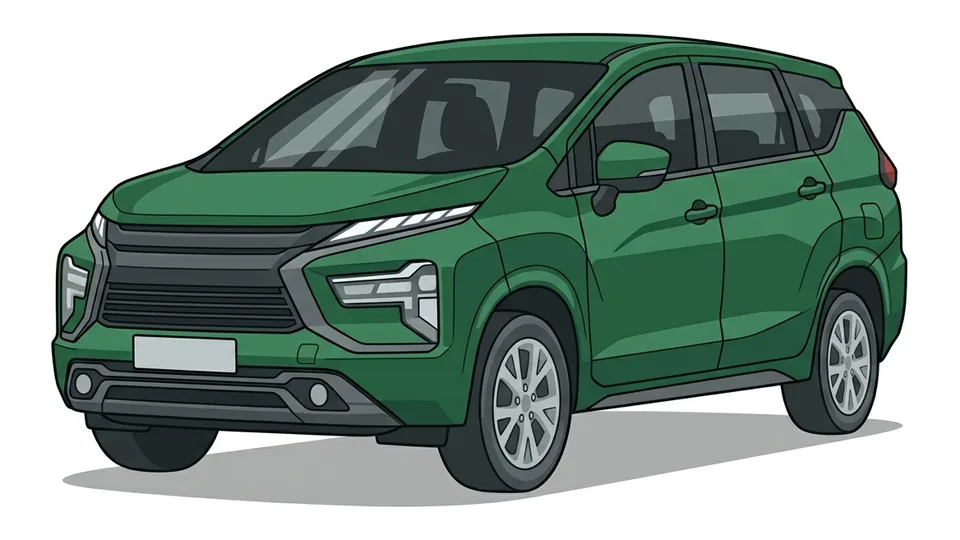
Mitsubishi Xpander 1.5 petrol (4A91)Every fluid, from the owner’s manual · 2023 manual
Every fluid for the Mitsubishi Xpander 1.5 petrol (4A91) with CVT, from the 2023 Thai owner's manual published on Mitsubishi Motors Thailand's website. A common mix-up is engine oil: the manual allows thin grades such as 0W-20 or 5W-30 only if the oil meets ACEA A3/B3, A3/B4 or A5/B5 and API SG or higher.
| System | Type / spec in the manual | Capacity (reference) | Change interval | Products here whose label lists the manual grade |
|---|---|---|---|---|
| Engine oil | SAE 0W-20, 5W-20, 0W-30, 5W-30, 5W-40 (must meet ACEA A3/B3, A3/B4 or A5/B5 and API SG or higher) · or 10W-30, 10W-40, 10W-50, 15W-40, 20W-40 etc. by temperature chart · additives not recommendedSource [1] p. 10-5, 11-9 | Oil pan 3.8 L + filter 0.2 L | See owner's manual | |
| CVT fluid | Mitsubishi CVT Fluid-MA1 onlySource [1] p. 11-9 | 7.5 L | See owner's manual | None on this site yet |
| Brake fluid | DOT 3 or DOT 4 from a tightly sealed containerSource [1] p. 10-7, 11-9 | As required | See owner's manual | |
| Engine coolant | MITSUBISHI MOTORS GENUINE SUPER LONG LIFE COOLANT PREMIUM or equivalent (ethylene glycol, free of borate, nitrite, amine and silicate, hybrid organic technology for long life)Source [1] p. 10-6, 11-9 | 5.0 L (including 0.65 L reserve tank) | See owner's manual |
General information compiled from the owner's manual. Always check your own manual or a service centre before filling — especially automatic/CVT fluid, where the wrong type can damage the transmission. This is not an official site of any carmaker, and linked products are not approved by the carmaker; they are products whose label lists the grade named in the manual.
Watch out for
- The CVT must use Mitsubishi CVT Fluid-MA1 only; the manual warns other fluids may damage the transmission.
- This Thai manual covers the Xpander only and does not mention the Cross, so this page is not a reference for the Xpander Cross.
- The manual has no service intervals (they are in a separate maintenance booklet), and as a front-wheel-drive car it lists no differential or transfer oil.
Sources
Further reading
Engine oil for sedans, eco cars and hybrids — SP vs SQ and which viscosity to use
Which engine oil grade suits a sedan, eco car or hybrid, how API SP and SQ differ, what ILSAC GF-7 means, and why the manual's viscosity comes first.
Read guide →What is ACEA? How to choose engine oil for a European car — A3/B4, C3 and OEM approvals
What ACEA means, how A3/B4, A5/B5, A7/B7 and C2, C3, C5, C6 differ, why European cars need the manufacturer approval in the manual, and how API and ACEA fit together.
Read guide →CVT shudder, sluggish pull or whine — what you can check and when to go to the dealer
CVT shudders pulling away, feels sluggish or whines? What to check first, how wrong or aged fluid fits in, Yaris Ativ and City Turbo intervals, and how hybrids differ.
Read guide →How often to change engine oil — match the interval to how you actually drive
How many kilometers or months between oil changes, how normal and severe intervals differ, whether full synthetic really stretches the interval, and signs to check.
Read guide →ATF vs CVT fluid — how they differ, can you swap them, and matching the spec
How stepped automatics, CVTs and manual gearboxes use different fluids, why ATF can't replace CVT fluid, and how to read DEXRON, JASO 1A, GL-4 and GL-5.
Read guide →DOT 3, DOT 4, DOT 5.1 brake fluid — the difference, mixing, and how often to change
What the DOT number means, whether DOT 4 can replace DOT 3, why DOT 5 must never be mixed, and why brake fluid needs changing on time even if you rarely drive.
Read guide →Radiator coolant — can you use plain water, and premixed vs concentrate
Why a radiator needs coolant, not plain water, how premixed and concentrate differ, what color does and doesn't tell you, mixing brands, and checking the level safely.
Read guide →Other models
- Ford Everest 2.0 diesel turbo / bi-turbo 2026 manual
- Ford Focus 1.6 / 1.8 / 2.0 petrol 2005 manual
- Ford Ranger 2.0 diesel turbo / bi-turbo 2022 manual
- Honda City Hatchback 1.0 turbo petrol CVT 2026 manual
- Honda Civic 2.0 e:HEV hybrid 2026 manual
- Honda Civic FD 1.8 petrol (R18A) 2006 manual
- Honda Click-i 110 fuel-injected 2009 manual
- Honda CR-V 2.0 e:HEV hybrid 2026 manual
- Honda HR-V 1.5 e:HEV hybrid 2022 manual
- Honda Zoomer-X 110 (108 cc) 2012 manual
- Isuzu D-Max 1.9 Ddi diesel (RZ4E-TC) 2024 manual
- Isuzu D-Max 3.0 Ddi diesel (4JJ3-TCX) 2026 manual
- Isuzu MU-X 1.9 / 3.0 diesel (RZ4F-TC / 4JJ3-TCX) 2026 manual
- Isuzu MU-X 1.9 diesel, older engine (RZ4E-TC) 2025 manual
- Mazda Mazda2 1.3 petrol / 1.5 diesel (SKYACTIV-G/D) 2023 manual
- Mitsubishi Pajero Sport 2.4 diesel (4N16) 2026 manual
- Mitsubishi Triton 2.4 diesel (4N16) 2024 manual
- Nissan Almera 1.0 turbo (HRA0DET) 2026 manual
- Nissan Navara 2.3 diesel (YS23DDT/DDTT) 2025 manual
- Toyota Camry ACV40 2.0/2.4 petrol (1AZ/2AZ-FE) 2006 manual
- Toyota Corolla Altis 1.8 petrol / hybrid (2ZR) 2026 manual
- Toyota Corolla Cross Hybrid 1.8 hybrid (2ZR-FXE) 2025 manual
- Toyota Fortuner 2.4 / 2.8 diesel (2GD/1GD-FTV) 2024 manual
- Toyota Hilux Champ 2.4 diesel / 2.0, 2.7 petrol 2025 manual
- Toyota Hilux Revo 2.4 diesel (2GD-FTV) 2024 manual
- Toyota Hilux Revo 2.8 diesel (1GD-FTV) 2025 manual
- Toyota Veloz 1.5 petrol (2NR-VE) 2023 manual
- Toyota Yaris Ativ 1.2 petrol (3NR-VE) CVT 2023 manual
- Toyota Yaris Ativ Hybrid 1.5 hybrid (2NR-VEX) 2025 manual
- Toyota Yaris Cross Hybrid 1.5 hybrid (2NR-VEX) 2023 manual
- Yamaha Aerox 155 liquid-cooled 155 cc 2026 manual
- Yamaha Finn 115i air-cooled 114 cc 2026 manual
- Yamaha Fino 125 air-cooled 125 cc 2021 manual
- Yamaha Grand Filano Hybrid air-cooled 125 cc 2026 manual
- Yamaha NMAX 155 liquid-cooled 155 cc 2026 manual
Product links on this site are Shopee Affiliate links. We may earn a commission on purchases made through them, at no extra cost to you.