Oil consumption has been reported on the 2.4 (2AZ-FE) engine used in Toyota models from about 2006–2011, and Toyota USA did publish technical documents on it. But those are US-market documents, and no source confirms a similar program in Thailand. If your Camry ACV40 2.4 needs frequent top-ups, measure the rate first, then ask a Toyota service center.
1. Which engine is this about?
The Thai Camry ACV40 came with two engines: the 2.0 (1AZ-FE) and the 2.4 (2AZ-FE). The Toyota documents found cover the 2AZ engine only. No official document describing the same problem on the 1AZ-FE was found, so this article draws no conclusion about the 1AZ.
The Thai owner’s manual gives one shared fluid value for both engines. See the Camry ACV40 fluid table.
2. What Toyota USA says (US market)
This section comes from documents Toyota sent to its dealers and filed with the US regulator NHTSA. They apply to US-market vehicles that match the listed VINs.
- TSB T-SB-0158-14 says some vehicles with the 2AZ-FE or 2AZ-FXE engine may consume engine oil, and that the piston assembly was changed to minimize it.
- TSB T-SB-0030-15 is the repair procedure: replace the piston and piston ring set. The inspection test in T-SB-0158-14 must be passed first.
- Warranty Enhancement Program ZE7 extends warranty coverage for parts replacement on vehicles that pass the test criteria. In the US, eligible Camry models are certain 2007–2009 (Camry Hybrid 2007–2011). Primary coverage ran to 31 Oct 2016 regardless of mileage; afterwards, 10 years from first use or 150,000 miles, whichever comes first.
These do not apply to Thai-market cars, and US model years and VINs do not automatically match a Thai ACV40. Do not assume a Thai service center will honor it. Ask them directly.
3. How to measure the consumption rate
Toyota USA has dealers test this way. Dealers seal the dipstick, drain plug, fill cap and other points to prevent tampering. Owners can follow the same idea, but the result is only your own reference figure, not an official test.
- Park on level ground, fill to the Full mark on the dipstick, and note the odometer.
- Drive normally for about 1,100–1,300 miles (roughly 1,770–2,090 km).
- Park on level ground and check the level again.
- See how much oil it takes to get back to Full.
The TSB criterion: when the car returns, add 1 US quart (about 0.95 L) from a bottle, run the engine until warm, shut off, wait 5 minutes. If the level is still below Full, consumption is over the threshold. If it reads Full or above, it is not. This is the TSB threshold for the US market, not a Thai service-center standard.
Notes
- If an oil change is due before you start, the TSB recommends changing it first for a valid result.
- There must be no external leaks. Fix any first.
- Home results vary with how level the car is and how long you wait before reading the dipstick.
For reading the dipstick and telling leaks from burning, see Checking oil level and consumption.
4. Symptoms and what to do
| Symptom | Possible cause | What to do |
|---|---|---|
| Level drops, frequent top-ups | Oil burned in the combustion chamber, or a leak | Measure per section 3, look for leaks |
| Blue-grey exhaust smoke | Oil is being burned | See a mechanic |
| Oily spark plugs | Oil reaching the combustion chamber | See a mechanic |
| Engine shake, check-engine light | The TSB notes a misfire code (P030#) can accompany oil consumption | See a mechanic |
| Oil pressure warning light on | Low oil or pressure loss | Stop in a safe place and shut off the engine immediately, then contact a service center (per the Toyota Yaris Ativ manual) |
The oil pressure light is not a low-level warning. If it comes on, do not keep driving to find oil.
A different oil grade does not repair the cause. Toyota’s own fix, per the US TSB, is replacing parts.
5. Choosing a grade from the Thai manual
The Thai Camry ACV40 manual (Toyota Motor Thailand, Oct 2006) allows two groups, chosen by the temperature chart:
| Group | Grades | Standard listed in manual |
|---|---|---|
| Thinner | 10W-30 or 5W-30 | API SL/SM Energy-Conserving, or ILSAC |
| Thicker | 15W-40 or 20W-50 | API SL or SM |
0W-20 is not in the Thai manual (the 0W-20 seen on overseas sites comes from overseas manuals). Capacity is 4.3 L with filter; normal interval is 10,000 km or 12 months, severe use 5,000 km or 6 months.
6. When to consider a thicker grade
Use the same criteria as in Mileage and oil grade and Can you change oil viscosity?
- The new grade must be in the manual’s list (for example moving from 5W-30 to 15W-40 or 20W-50 according to the manual’s temperature chart), never off the list.
- You have measured the rate and it is genuinely high, with no leaks.
- No blue smoke or other symptom that needs repair.
A thicker grade does not repair rings or pistons and may delay a visit to a mechanic. No official source confirms that a thicker grade reduces 2AZ oil consumption, so no result is promised. If you try it, change grade for one oil-change interval and re-measure against the old rate.
Additives are not a fix for oil consumption. See Are engine oil additives worth it?
7. Cars with 200,000 km or more
- If the engine has been repaired or replaced and the history is unknown, start measuring afresh.
- Check the level every 2–4 weeks and before long trips; log odometer and level each time.
- Toyota’s manuals for other Thai models (Yaris Ativ, Corolla, Camry Hybrid) say consumption rises with low-quality or unsuitable oil, high revs, and long idling or heavy traffic. Rule those out before blaming the engine.
- Top up to the proper level before long drives; never let it get close to the low mark.
8. Oils on this site that match the manual’s list
Checked against the label data in each product entry. It does not mean they fix oil consumption.
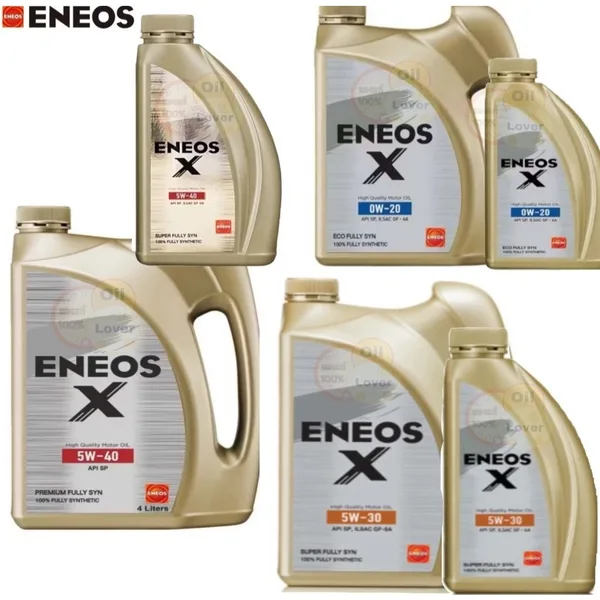
- ENEOS X 5W-30 / 5W-40 — the 5W-30 label lists API SP and ILSAC GF-6A. Use only the 5W-30, which is in the manual’s list (5W-40 is not).
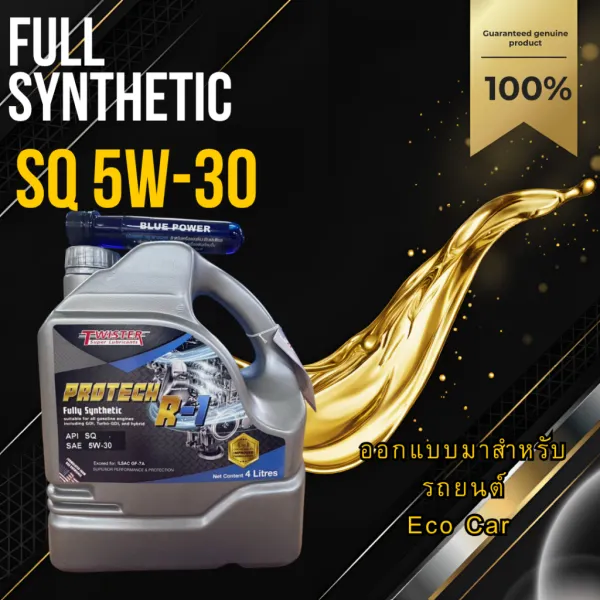
- PROTECH R-1 SQ 5W-30 — API SQ, ILSAC GF-7A.
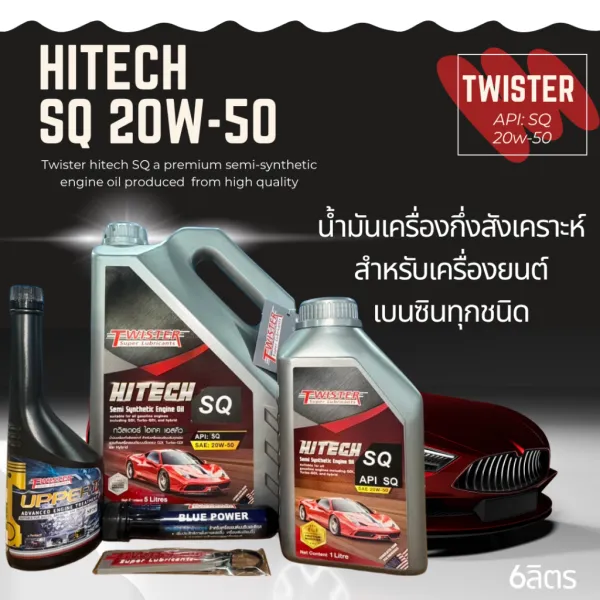
- HITECH SQ 20W-50 — API SQ; 20W-50 is the thicker group in the manual (label category is newer than SL/SM).
Quick summary
- Toyota’s documented problem is the 2AZ engine (2.4); no document confirms the same for the 1AZ (2.0).
- The TSB and ZE7 program are US-market. No Thai source confirms one; ask a Toyota service center.
- Measure: fill to Full, note odometer, drive about 1,770–2,090 km, add 1 quart, see whether it reaches Full.
- Grade must be in the Thai manual’s list (5W-30/10W-30 or 15W-40/20W-50). A thicker grade does not fix the cause.
- Blue smoke, oily plugs, oil pressure light → see a mechanic; oil pressure light on = stop immediately.
See products in gasoline engine oil